In cryptography, format-preserving encryption (FPE), refers to encrypting in such a way that the output (the ciphertext) is in the same format as the input (the plaintext). The meaning of "format" varies. Typically only finite sets of characters are used; numeric, alphabetic or alphanumeric. For example: Encrypting a 16-digit credit card number so that the ciphertext is another 16-digit number. Encrypting an English word so that the ciphertext is another English word. Encrypting an n-bit number so that the ciphertext is another n-bit number (this is the definition of an n-bit block cipher). For such finite domains, and for the purposes of the discussion below, the cipher is equivalent to a permutation of N integers {0, ... , N−1} where N is the size of the domain. == Motivation == === Restricted field lengths or formats === One motivation for using FPE comes from the problems associated with integrating encryption into existing applications, with well-defined data models. A typical example would be a credit card number, such as 1234567812345670 (16 bytes long, digits only). Adding encryption to such applications might be challenging if data models are to be changed, as it usually involves changing field length limits or data types. For example, output from a typical block cipher would turn credit card number into a hexadecimal (e.g.0x96a45cbcf9c2a9425cde9e274948cb67, 34 bytes, hexadecimal digits) or Base64 value (e.g. lqRcvPnCqUJc3p4nSUjLZw==, 24 bytes, alphanumeric and special characters), which will break any existing applications expecting the credit card number to be a 16-digit number. Apart from simple formatting problems, using AES-128-CBC, this credit card number might get encrypted to the hexadecimal value 0xde015724b081ea7003de4593d792fd8b695b39e095c98f3a220ff43522a2df02. In addition to the problems caused by creating invalid characters and increasing the size of the data, data encrypted using the CBC mode of an encryption algorithm also changes its value when it is decrypted and encrypted again. This happens because the random seed value that is used to initialize the encryption algorithm and is included as part of the encrypted value is different for each encryption operation. Because of this, it is impossible to use data that has been encrypted with the CBC mode as a unique key to identify a row in a database. FPE attempts to simplify the transition process by preserving the formatting and length of the original data, allowing a drop-in replacement of plaintext values with their ciphertexts in legacy applications. == Comparison to truly random permutations == Although a truly random permutation is the ideal FPE cipher, for large domains it is infeasible to pre-generate and remember a truly random permutation. So the problem of FPE is to generate a pseudorandom permutation from a secret key, in such a way that the computation time for a single value is small (ideally constant, but most importantly smaller than O(N)). == Comparison to block ciphers == An n-bit block cipher technically is a FPE on the set {0, ..., 2n-1}. If an FPE is needed on one of these standard sized sets (for example, n = 64 for DES and n = 128 for AES) a block cipher of the right size can be used. However, in typical usage, a block cipher is used in a mode of operation that allows it to encrypt arbitrarily long messages, and with an initialization vector as discussed above. In this mode, a block cipher is not an FPE. == Definition of security == In cryptographic literature (see most of the references below), the measure of a "good" FPE is whether an attacker can distinguish the FPE from a truly random permutation. Various types of attackers are postulated, depending on whether they have access to oracles or known ciphertext/plaintext pairs. == Algorithms == In most of the approaches listed here, a well-understood block cipher (such as AES) is used as a primitive to take the place of an ideal random function. This has the advantage that incorporation of a secret key into the algorithm is easy. Where AES is mentioned in the following discussion, any other good block cipher would work as well. === The FPE constructions of Black and Rogaway === Implementing FPE with security provably related to that of the underlying block cipher was first undertaken in a paper by cryptographers John Black and Phillip Rogaway, which described three ways to do this. They proved that each of these techniques is as secure as the block cipher that is used to construct it. This means that if the AES algorithm is used to create an FPE algorithm, then the resulting FPE algorithm is as secure as AES because an adversary capable of defeating the FPE algorithm can also defeat the AES algorithm. Therefore, if AES is secure, then the FPE algorithms constructed from it are also secure. In all of the following, E denotes the AES encryption operation that is used to construct an FPE algorithm and F denotes the FPE encryption operation. ==== FPE from a prefix cipher ==== One simple way to create an FPE algorithm on {0, ..., N-1} is to assign a pseudorandom weight to each integer, then sort by weight. The weights are defined by applying an existing block cipher to each integer. Black and Rogaway call this technique a "prefix cipher" and showed it was provably as good as the block cipher used. Thus, to create an FPE on the domain {0,1,2,3}, given a key K apply AES(K) to each integer, giving, for example, weight(0) = 0x56c644080098fc5570f2b329323dbf62 weight(1) = 0x08ee98c0d05e3dad3eb3d6236f23e7b7 weight(2) = 0x47d2e1bf72264fa01fb274465e56ba20 weight(3) = 0x077de40941c93774857961a8a772650d Sorting [0,1,2,3] by weight gives [3,1,2,0], so the cipher is F(0) = 3 F(1) = 1 F(2) = 2 F(3) = 0 This method is only useful for small values of N. For larger values, the size of the lookup table and the required number of encryptions to initialize the table gets too big to be practical. ==== FPE from cycle walking ==== If there is a set M of allowed values within the domain of a pseudorandom permutation P (for example P can be a block cipher like AES), an FPE algorithm can be created from the block cipher by repeatedly applying the block cipher until the result is one of the allowed values (within M). CycleWalkingFPE(x) { if P(x) is an element of M then return P(x) else return CycleWalkingFPE(P(x)) } The recursion is guaranteed to terminate. (Because P is one-to-one and the domain is finite, repeated application of P forms a cycle, so starting with a point in M the cycle will eventually terminate in M.) This has the advantage that the elements of M do not have to be mapped to a consecutive sequence {0,...,N-1} of integers. It has the disadvantage, when M is much smaller than P's domain, that too many iterations might be required for each operation. If P is a block cipher of a fixed size, such as AES, this is a severe restriction on the sizes of M for which this method is efficient. For example, an application may want to encrypt 100-bit values with AES in a way that creates another 100-bit value. With this technique, AES-128-ECB encryption can be applied until it reaches a value which has all of its 28 highest bits set to 0, which will take an average of 228 iterations to happen. ==== FPE from a Feistel network ==== It is also possible to make a FPE algorithm using a Feistel network. A Feistel network needs a source of pseudo-random values for the sub-keys for each round, and the output of the AES algorithm can be used as these pseudo-random values. When this is done, the resulting Feistel construction is good if enough rounds are used. One way to implement an FPE algorithm using AES and a Feistel network is to use as many bits of AES output as are needed to equal the length of the left or right halves of the Feistel network. If a 24-bit value is needed as a sub-key, for example, it is possible to use the lowest 24 bits of the output of AES for this value. This may not result in the output of the Feistel network preserving the format of the input, but it is possible to iterate the Feistel network in the same way that the cycle-walking technique does to ensure that format can be preserved. Because it is possible to adjust the size of the inputs to a Feistel network, it is possible to make it very likely that this iteration ends very quickly on average. In the case of credit card numbers, for example, there are 1015 possible 16-digit credit card numbers (accounting for the redundant check digit), and because the 1015 ≈ 249.8, using a 50-bit wide Feistel network along with cycle walking will create an FPE algorithm that encrypts fairly quickly on average. === The Thorp shuffle === A Thorp shuffle is like an idealized card-shuffle, or equivalently a maximally-unbalanced Feistel cipher where one side is a single bit. It is easier to prove security for unbalanced Feistel ciphers than for balanced ones. === VIL mode === For domain sizes that are a power of two, and an existing block cipher with a smaller bl
Statistical learning theory
Statistical learning theory is a framework for machine learning drawing from the fields of statistics and functional analysis. Statistical learning theory deals with the statistical inference problem of finding a predictive function based on data. Statistical learning theory has led to successful applications in fields such as computer vision, speech recognition, and bioinformatics. == Introduction == The goals of learning are understanding and prediction. Learning falls into many categories, including supervised learning, unsupervised learning, online learning, and reinforcement learning. From the perspective of statistical learning theory, supervised learning is best understood. Supervised learning involves learning from a training set of data. Every point in the training is an input–output pair, where the input maps to an output. The learning problem consists of inferring the function that maps between the input and the output, such that the learned function can be used to predict the output from future input. Depending on the type of output, supervised learning problems are either problems of regression or problems of classification. If the output takes a continuous range of values, it is a regression problem. Using Ohm's law as an example, a regression could be performed with voltage as input and current as an output. The regression would find the functional relationship between voltage and current to be R {\displaystyle R} , such that V = I R {\displaystyle V=IR} Classification problems are those for which the output will be an element from a discrete set of labels. Classification is very common for machine learning applications. In facial recognition, for instance, a picture of a person's face would be the input, and the output label would be that person's name. The input would be represented by a large multidimensional vector whose elements represent pixels in the picture. After learning a function based on the training set data, that function is validated on a test set of data, data that did not appear in the training set. == Formal description == Take X {\displaystyle X} to be the vector space of all possible inputs, and Y {\displaystyle Y} to be the vector space of all possible outputs. Statistical learning theory takes the perspective that there is some unknown probability distribution over the product space Z = X × Y {\displaystyle Z=X\times Y} , i.e. there exists some unknown p ( z ) = p ( x , y ) {\displaystyle p(z)=p(\mathbf {x} ,y)} . The training set is made up of n {\displaystyle n} samples from this probability distribution, and is notated S = { ( x 1 , y 1 ) , … , ( x n , y n ) } = { z 1 , … , z n } {\displaystyle S=\{(\mathbf {x} _{1},y_{1}),\dots ,(\mathbf {x} _{n},y_{n})\}=\{\mathbf {z} _{1},\dots ,\mathbf {z} _{n}\}} Every x i {\displaystyle \mathbf {x} _{i}} is an input vector from the training data, and y i {\displaystyle y_{i}} is the output that corresponds to it. In this formalism, the inference problem consists of finding a function f : X → Y {\displaystyle f:X\to Y} such that f ( x ) ∼ y {\displaystyle f(\mathbf {x} )\sim y} . Let H {\displaystyle {\mathcal {H}}} be a space of functions f : X → Y {\displaystyle f:X\to Y} called the hypothesis space. The hypothesis space is the space of functions the algorithm will search through. Let V ( f ( x ) , y ) {\displaystyle V(f(\mathbf {x} ),y)} be the loss function, a metric for the difference between the predicted value f ( x ) {\displaystyle f(\mathbf {x} )} and the actual value y {\displaystyle y} . The expected risk is defined to be I [ f ] = ∫ X × Y V ( f ( x ) , y ) p ( x , y ) d x d y {\displaystyle I[f]=\int _{X\times Y}V(f(\mathbf {x} ),y)\,p(\mathbf {x} ,y)\,d\mathbf {x} \,dy} The target function, the best possible function f {\displaystyle f} that can be chosen, is given by the f {\displaystyle f} that satisfies f = argmin h ∈ H I [ h ] {\displaystyle f=\mathop {\operatorname {argmin} } _{h\in {\mathcal {H}}}I[h]} Because the probability distribution p ( x , y ) {\displaystyle p(\mathbf {x} ,y)} is unknown, a proxy measure for the expected risk must be used. This measure is based on the training set, a sample from this unknown probability distribution. It is called the empirical risk I S [ f ] = 1 n ∑ i = 1 n V ( f ( x i ) , y i ) {\displaystyle I_{S}[f]={\frac {1}{n}}\sum _{i=1}^{n}V(f(\mathbf {x} _{i}),y_{i})} A learning algorithm that chooses the function f S {\displaystyle f_{S}} that minimizes the empirical risk is called empirical risk minimization. == Loss functions == The choice of loss function is a determining factor on the function f S {\displaystyle f_{S}} that will be chosen by the learning algorithm. The loss function also affects the convergence rate for an algorithm. It is important for the loss function to be convex. Different loss functions are used depending on whether the problem is one of regression or one of classification. === Regression === The most common loss function for regression is the square loss function (also known as the L2-norm). This familiar loss function is used in Ordinary Least Squares regression. The form is: V ( f ( x ) , y ) = ( y − f ( x ) ) 2 {\displaystyle V(f(\mathbf {x} ),y)=(y-f(\mathbf {x} ))^{2}} The absolute value loss (also known as the L1-norm) is also sometimes used: V ( f ( x ) , y ) = | y − f ( x ) | {\displaystyle V(f(\mathbf {x} ),y)=|y-f(\mathbf {x} )|} === Classification === In some sense the 0-1 indicator function is the most natural loss function for classification. It takes the value 0 if the predicted output is the same as the actual output, and it takes the value 1 if the predicted output is different from the actual output. For binary classification with Y = { − 1 , 1 } {\displaystyle Y=\{-1,1\}} , this is: V ( f ( x ) , y ) = θ ( − y f ( x ) ) {\displaystyle V(f(\mathbf {x} ),y)=\theta (-yf(\mathbf {x} ))} where θ {\displaystyle \theta } is the Heaviside step function. == Regularization == In machine learning problems, a major problem that arises is that of overfitting. Because learning is a prediction problem, the goal is not to find a function that most closely fits the (previously observed) data, but to find one that will most accurately predict output from future input. Empirical risk minimization runs this risk of overfitting: finding a function that matches the data exactly but does not predict future output well. Overfitting is symptomatic of unstable solutions; a small perturbation in the training set data would cause a large variation in the learned function. It can be shown that if the stability for the solution can be guaranteed, generalization and consistency are guaranteed as well. Regularization can solve the overfitting problem and give the problem stability. Regularization can be accomplished by restricting the hypothesis space H {\displaystyle {\mathcal {H}}} . A common example would be restricting H {\displaystyle {\mathcal {H}}} to linear functions: this can be seen as a reduction to the standard problem of linear regression. H {\displaystyle {\mathcal {H}}} could also be restricted to polynomial of degree p {\displaystyle p} , exponentials, or bounded functions on L1. Restriction of the hypothesis space avoids overfitting because the form of the potential functions are limited, and so does not allow for the choice of a function that gives empirical risk arbitrarily close to zero. One example of regularization is Tikhonov regularization. This consists of minimizing 1 n ∑ i = 1 n V ( f ( x i ) , y i ) + γ ‖ f ‖ H 2 {\displaystyle {\frac {1}{n}}\sum _{i=1}^{n}V(f(\mathbf {x} _{i}),y_{i})+\gamma \left\|f\right\|_{\mathcal {H}}^{2}} where γ {\displaystyle \gamma } is a fixed and positive parameter, the regularization parameter. Tikhonov regularization ensures existence, uniqueness, and stability of the solution. == Bounding empirical risk == Consider a binary classifier f : X → { 0 , 1 } {\displaystyle f:{\mathcal {X}}\to \{0,1\}} . We can apply Hoeffding's inequality to bound the probability that the empirical risk deviates from the true risk to be a Sub-Gaussian distribution. P ( | R ^ ( f ) − R ( f ) | ≥ ϵ ) ≤ 2 e − 2 n ϵ 2 {\displaystyle \mathbb {P} (|{\hat {R}}(f)-R(f)|\geq \epsilon )\leq 2e^{-2n\epsilon ^{2}}} But generally, when we do empirical risk minimization, we are not given a classifier; we must choose it. Therefore, a more useful result is to bound the probability of the supremum of the difference over the whole class. P ( sup f ∈ F | R ^ ( f ) − R ( f ) | ≥ ϵ ) ≤ 2 S ( F , n ) e − n ϵ 2 / 8 ≈ n d e − n ϵ 2 / 8 {\displaystyle \mathbb {P} {\bigg (}\sup _{f\in {\mathcal {F}}}|{\hat {R}}(f)-R(f)|\geq \epsilon {\bigg )}\leq 2S({\mathcal {F}},n)e^{-n\epsilon ^{2}/8}\approx n^{d}e^{-n\epsilon ^{2}/8}} where S ( F , n ) {\displaystyle S({\mathcal {F}},n)} is the shattering number and n {\displaystyle n} is the number of samples in your dataset. The exponential term comes from Hoeffding but there is an extra cost of taking the supremum over the whole cla
Personal network
A personal network is a set of human contacts known to an individual, with whom that individual would expect to interact at intervals to support a given set of activities. In other words, a personal network is a group of caring, dedicated people who are committed to maintain a relationship with a person in order to support a given set of activities. Having a strong personal network requires being connected to a network of resources for mutual development and growth. Personal networks can be understood by: who knows you what you know about them what they know about you what are you learning together how you work at that Personal networks are intended to be mutually beneficial, extending the concept of teamwork beyond the immediate peer group. The term is usually encountered in the workplace, though it could apply equally to other pursuits outside work. Personal networking is the practice of developing and maintaining a personal network, which is usually undertaken over an extended period. The concept is related to business networking and is often encouraged by large organizations, in the hope of improving productivity, and so a number of tools exist to support the maintenance of networks. Many of these tools are IT-based, and use Web 2.0 technologies. == History of networking and business success == In the second half of the twentieth century, U.S. advocates for workplace equity popularized the term and concept of networking as part of a larger social capital lexicon—which also includes terms such as glass ceiling, role model, mentoring, and gatekeeper—serving to identify and address the problems barring non-dominant groups from professional success. Mainstream business literature subsequently adopted the terms and concepts, promoting them as pathways to success for all career climbers. In 1970 these terms were not in the general American vocabulary; by the mid-1990s they had become part of everyday speech. Before the mid-twentieth century, what we call networking today was framed in the language of family and friendship. These close personal relationships provided a range of opportunities to preferred subsets of people, such as access to job opportunities, information, credit, and partnerships. Family networks and nepotism have proven particularly strong throughout history. However, other common bonds—from ethnicity and religion to school ties and club memberships—can connect subsets of people as well. Of course people whom insiders consider undesirable have been barred from such networks, with important consequences. Those who tap into influential networks can be nurtured toward success. Those who are shut out from networks can lose hope of success. Numerous business heroes of the past—such as Benjamin Franklin, Andrew Carnegie, Henry Ford, and John D. Rockefeller—exploited networks to great effect. The business networks that seemed natural and transparent to these white men were a closed book to women and minorities for much of American history. Drawing on work from the social sciences, these outsider groups had to identify and then harness the mechanisms behind networking's power. A prominent early example of this process was the formation of corporate caucuses by black men at Xerox starting in 1969. Groups of black salesmen met regularly to share information about Xerox's culture and strategies for navigating it most effectively. Through confrontation and collaboration with a relatively accommodating upper management, the caucuses helped open opportunities for high-performing black employees. The popular and business press began using the terms "network" and "networking" in the mid-1970s in the context of businesswomen consciously pursuing this strategy. Authors encouraged female workers to recognize and exploit the informal workplace systems that provided advancement. They urged women to identify mentors, use social contacts, and build peer and authority networks. The push for networking drew on ideas and relationships from the era's feminist movement, and dictionaries of the time explicitly linked business networking to women's efforts to succeed in the workplace. Since the closing decades of the twentieth century, networking has become a pervasive term and concept in American society. People now invoke networking in relation to everything from business to child rearing to science. While ambitious careerists seek networks as an indispensable talisman, companies purposefully encourage networking among their employees to boost performance and gain competitive advantage. At the same time, Americans are forgetting the workplace activism that first illuminated the power of networking. Unfortunately, this loss of historical context can fuel a backlash against outsider groups who still seek to synthesize networks so they can access the same opportunities enjoyed by insiders. == Characteristics of networks == Broadly speaking, all networks have the following characteristics: Purpose – A network can be established for learning, mission, business, idea, and family or personal reasons. Structure – A network is a group of interlinked entities that form a cluster. Most social structures tend to be characterized by dense clusters of strong connections. Style – The place, space, pace and style of interaction of the networks give an understanding of the style of the networks. Namkee Park, Seungyoon Lee and Jang Hyun Kim examined the relations between personal network characteristics and Facebook use. According to their study, personal networks are investigated through several structural characteristics, which can be categorized into three major dimensions according to the level of analysis: Dyadic tie attributes which include the characteristics of ego-alter ties such as duration, multiplexity, and proximity. Ego-alter tie attributes represent various dimensions of relationships between the focal person and their close contacts. First, tie duration refers to the length of time since the tie was originally initiated, which indicates the duration of relationships. Second, multiplexity includes a focal individual's degree of involvement in various types of interactions with network members. The third dimension is the physical proximity between ego and alter. Theories of proximity suggest that physical proximity between people affects their interaction and subsequently, their formation of network ties. The characteristics of alter-alter ties including personal network density. When moving to ties at the alter-alter level, ego-network density, which refers to the extent to which one's alters are connected with each other, is an important dimension of personal networks. Dense personal network structure indicates close interpersonal contacts among alters, and consequently, is considered to promote the sharing of resources. On the other hand, loose connections, or structural holes in ego-networks, have been found to facilitate the flow of information and to provide advantages in searching and obtaining resources (e.g., getting a job). The composition of alter attributes centered on the heterogeneity of alters in one's personal network. The heterogeneity of alters in one's personal network is associated with access to diverse resources and information It is expected, thus, that the heterogeneity attributes may enhance the focal actor's social activities. Each of these characteristics represents unique aspects of individuals' network relationships. == Types of personal networks == Personal networks can be used for two main reasons: social and professional. In 2012, LinkedIn along with TNS conducted a survey of 6,000 social network users to understand the difference between personal social networks and personal professional networks. The "Mindset Divide" of users of these networks was compared as follows: Emotions: Personal social networks: Nostalgia, fun, distraction. Personal professional networks: Achievement, success, aspiration. Use: Personal social networks: Users are in a casual mindset often just passing time. They use social networks to socialize, stay in touch, be entertained and kill time. Personal professional networks: In this purposeful mindset, users invest time to improve themselves and their future. These networks are used to maintain professional identity, make useful contacts, search for opportunities and stay in touch. Content: Personal professional networks: These provide information about career, brand updates and current affairs. Professional development: Personal development networks: These provide access to those who can provide information, knowledge, advice, support, expertise, guidance, and concrete resources to learn and work effectively—thus those who support the continuing professional development. == Personal network management == Personal network management (PNM) is a crucial aspect of personal information management and can be understood as the practice of managing the links and connections for social and profession
Kerckhoffs's principle
Kerckhoffs's principle (also called Kerckhoffs's desideratum, assumption, axiom, doctrine or law) of cryptography was stated by the Dutch cryptographer Auguste Kerckhoffs in the 19th century. The principle holds that a cryptosystem should be secure, even if everything about the system, except the key, is public knowledge. This concept is widely embraced by cryptographers, in contrast to security through obscurity, which is not. Kerckhoffs's principle was phrased by the American mathematician Claude Shannon as "the enemy knows the system", i.e., "one ought to design systems under the assumption that the enemy will immediately gain full familiarity with them". In that form, it is called Shannon's maxim. Another formulation by American researcher and professor Steven M. Bellovin is: In other words—design your system assuming that your opponents know it in detail. (A former official at NSA's National Computer Security Center told me that the standard assumption there was that serial number 1 of any new device was delivered to the Kremlin.) == Origins == The invention of telegraphy radically changed military communications and increased the number of messages that needed to be protected from the enemy dramatically, leading to the development of field ciphers which had to be easy to use without large confidential codebooks prone to capture on the battlefield. It was this environment which led to the development of Kerckhoffs's requirements. Auguste Kerckhoffs was a professor of German language at Ecole des Hautes Etudes Commerciales (HEC) in Paris. In early 1883, Kerckhoffs's article, La Cryptographie Militaire, was published in two parts in the Journal of Military Science, in which he stated six design rules for military ciphers. Translated from French, they are: The system must be practically, if not mathematically, indecipherable; It should not require secrecy, and it should not be a problem if it falls into enemy hands; It must be possible to communicate and remember the key without using written notes, and correspondents must be able to change or modify it at will; It must be applicable to telegraph communications; It must be portable, and should not require several persons to handle or operate; Lastly, given the circumstances in which it is to be used, the system must be easy to use and should not be stressful to use or require its users to know and comply with a long list of rules. Some are no longer relevant given the ability of computers to perform complex encryption. The second rule, now known as Kerckhoffs's principle, is still critically important. == Explanation of the principle == Kerckhoffs viewed cryptography as a rival to, and a better alternative than, steganographic encoding, which was common in the nineteenth century for hiding the meaning of military messages. One problem with encoding schemes is that they rely on humanly-held secrets such as "dictionaries" which disclose for example, the secret meaning of words. Steganographic-like dictionaries, once revealed, permanently compromise a corresponding encoding system. Another problem is that the risk of exposure increases as the number of users holding the secrets increases. Nineteenth century cryptography, in contrast, used simple tables which provided for the transposition of alphanumeric characters, generally given row-column intersections which could be modified by keys which were generally short, numeric, and could be committed to human memory. The system was considered "indecipherable" because tables and keys do not convey meaning by themselves. Secret messages can be compromised only if a matching set of table, key, and message falls into enemy hands in a relevant time frame. Kerckhoffs viewed tactical messages as only having a few hours of relevance. Systems are not necessarily compromised, because their components (i.e. alphanumeric character tables and keys) can be easily changed. === Advantage of secret keys === Using secure cryptography is supposed to replace the difficult problem of keeping messages secure with a much more manageable one, keeping relatively small keys secure. A system that requires long-term secrecy for something as large and complex as the whole design of a cryptographic system obviously cannot achieve that goal. It only replaces one hard problem with another. However, if a system is secure even when the enemy knows everything except the key, then all that is needed is to manage keeping the keys secret. There are a large number of ways the internal details of a widely used system could be discovered. The most obvious is that someone could bribe, blackmail, or otherwise threaten staff or customers into explaining the system. In war, for example, one side will probably capture some equipment and people from the other side. Each side will also use spies to gather information. If a method involves software, someone could do memory dumps or run the software under the control of a debugger in order to understand the method. If hardware is being used, someone could buy or steal some of the hardware and build whatever programs or gadgets needed to test it. Hardware can also be dismantled so that the chip details can be examined under the microscope. === Maintaining security === A generalization some make from Kerckhoffs's principle is: "The fewer and simpler the secrets that one must keep to ensure system security, the easier it is to maintain system security." Bruce Schneier ties it in with a belief that all security systems must be designed to fail as gracefully as possible: Kerckhoffs's principle applies beyond codes and ciphers to security systems in general: every secret creates a potential failure point. Secrecy, in other words, is a prime cause of brittleness—and therefore something likely to make a system prone to catastrophic collapse. Conversely, openness provides ductility. Any security system depends crucially on keeping some things secret. However, Kerckhoffs's principle points out that the things kept secret ought to be those least costly to change if inadvertently disclosed. For example, a cryptographic algorithm may be implemented by hardware and software that is widely distributed among users. If security depends on keeping that secret, then disclosure leads to major logistic difficulties in developing, testing, and distributing implementations of a new algorithm – it is "brittle". On the other hand, if keeping the algorithm secret is not important, but only the keys used with the algorithm must be secret, then disclosure of the keys simply requires the simpler, less costly process of generating and distributing new keys. == Applications == In accordance with Kerckhoffs's principle, the majority of civilian cryptography makes use of publicly known algorithms. By contrast, ciphers used to protect classified government or military information are often kept secret (see Type 1 encryption). However, it should not be assumed that government/military ciphers must be kept secret to maintain security. It is possible that they are intended to be as cryptographically sound as public algorithms, and the decision to keep them secret is in keeping with a layered security posture. == Security through obscurity == It is moderately common for companies to keep the inner workings of a system secret. Some argue this "security by obscurity" makes the product safer and less vulnerable to attack. A counter-argument is that keeping the innards secret may improve security in the short term, but in the long run, only systems that have been published and analyzed should be trusted. Steven Bellovin and Randy Bush commented: Security Through Obscurity Considered Dangerous Hiding security vulnerabilities in algorithms, software, and/or hardware decreases the likelihood they will be repaired and increases the likelihood that they can and will be exploited. Discouraging or outlawing discussion of weaknesses and vulnerabilities is extremely dangerous and deleterious to the security of computer systems, the network, and its citizens. Open Discussion Encourages Better Security The long history of cryptography and cryptoanalysis has shown time and time again that open discussion and analysis of algorithms exposes weaknesses not thought of by the original authors, and thereby leads to better and more secure algorithms. As Kerckhoffs noted about cipher systems in 1883 [Kerc83], "Il faut qu'il n'exige pas le secret, et qu'il puisse sans inconvénient tomber entre les mains de l'ennemi." (Roughly, "the system must not require secrecy and must be able to be stolen by the enemy without causing trouble.")
Voice inversion
Voice inversion scrambling is an analog method of obscuring the content of a transmission. It is sometimes used in public service radio, automobile racing, cordless telephones and the Family Radio Service. Without a descrambler, the transmission makes the speaker "sound like Donald Duck". Despite the term, the technique operates on the passband of the information and so can be applied to any information being transmitted. == Forms and details == There are various forms of voice inversion which offer differing levels of security. Overall, voice inversion scrambling offers little true security as software and even hobbyist kits are available from kit makers for scrambling and descrambling. The cadence of the speech is not changed. It is often easy to guess what is happening in the conversation by listening for other audio cues like questions, short responses and other language cadences. In the simplest form of voice inversion, the frequency p {\displaystyle p} of each component is replaced with s − p {\displaystyle s-p} , where s {\displaystyle s} is the frequency of a carrier wave. This can be done by amplitude modulating the speech signal with the carrier, then applying a low-pass filter to select the lower sideband. This will make the low tones of the voice sound like high ones and vice versa. This process also occurs naturally if a radio receiver is tuned to a single sideband transmission but set to decode the wrong sideband. There are more advanced forms of voice inversion which are more complex and require more effort to descramble. One method is to use a random code to choose the carrier frequency and then change this code in real time. This is called Rolling Code voice inversion and one can often hear the "ticks" in the transmission which signal the changing of the inversion point. Another method is split band voice inversion. This is where the band is split and then each band is inverted separately. A rolling code can also be added to this method for variable split band inversion (VSB). Common carrier frequencies are: 2.632 kHz, 2.718 kHz, 2.868 kHz, 3.023 kHz, 3.107 kHz, 3.196 kHz, 3.333 kHz, 3.339 kHz, 3.496 kHz, 3.729 kHz and 4.096 kHz. Voice inversion offers no security at all and software is available to restore the original voice, which is why it is no longer used to protect conversations today. However, voice inversion is still found in low-end Chinese walkie talkies.
Neurorobotics
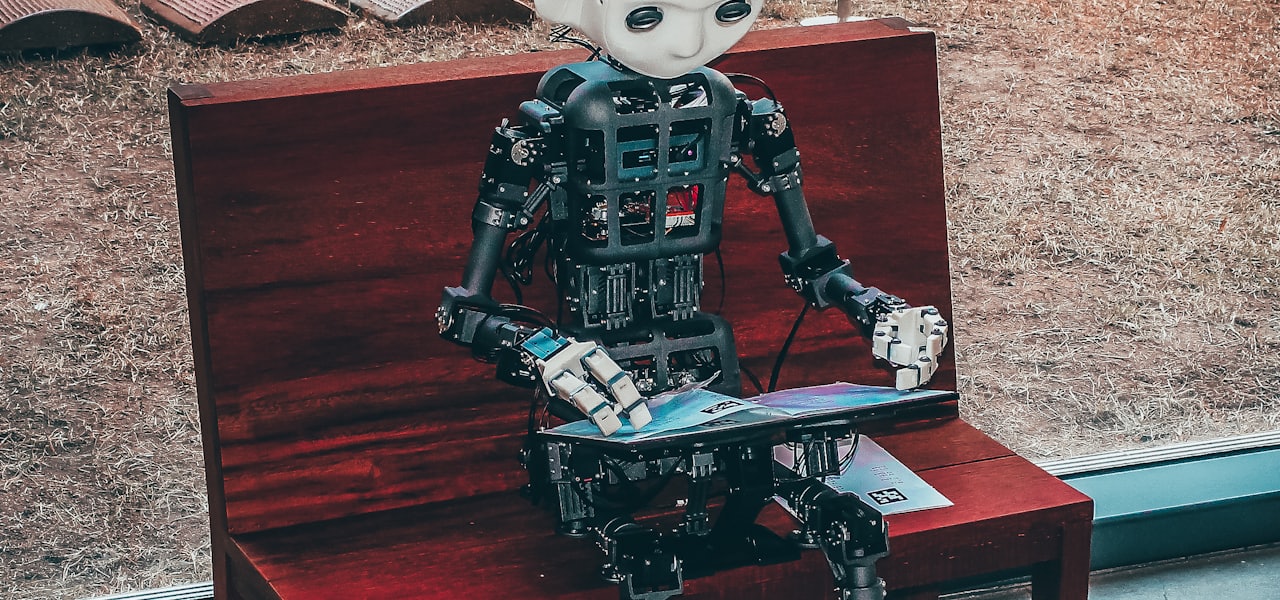
Neurorobotics is the combined study of neuroscience, robotics, and artificial intelligence. It is the science and technology of embodied autonomous neural systems. Neural systems include brain-inspired algorithms (e.g. connectionist networks), computational models of biological neural networks (e.g. artificial spiking neural networks, large-scale simulations of neural microcircuits) and actual biological systems (e.g. in vivo and in vitro neural nets). Such neural systems can be embodied in machines with mechanic or any other forms of physical actuation. This includes robots, prosthetic or wearable systems but also, at smaller scale, micro-machines and, at the larger scales, furniture and infrastructures. Neurorobotics is that branch of neuroscience with robotics, which deals with the study and application of science and technology of embodied autonomous neural systems like brain-inspired algorithms. It is based on the idea that the brain is embodied and the body is embedded in the environment. Therefore, most neurorobots are required to function in the real world, as opposed to a simulated environment. Beyond brain-inspired algorithms for robots neurorobotics may also involve the design of brain-controlled robot systems. == Major classes of models == Neurorobots can be divided into various major classes based on the robot's purpose. Each class is designed to implement a specific mechanism of interest for study. Common types of neurorobots are those used to study motor control, memory, action selection, and perception. === Locomotion and motor control === Neurorobots are often used to study motor feedback and control systems, and have proved their merit in developing controllers for robots. Locomotion is modeled by a number of neurologically inspired theories on the action of motor systems. Locomotion control has been mimicked using models or central pattern generators, clumps of neurons capable of driving repetitive behavior, to make four-legged walking robots. Other groups have expanded the idea of combining rudimentary control systems into a hierarchical set of simple autonomous systems. These systems can formulate complex movements from a combination of these rudimentary subsets. This theory of motor action is based on the organization of cortical columns, which progressively integrate from simple sensory input into a complex afferent signals, or from complex motor programs to simple controls for each muscle fiber in efferent signals, forming a similar hierarchical structure. Another method for motor control uses learned error correction and predictive controls to form a sort of simulated muscle memory. In this model, awkward, random, and error-prone movements are corrected for using error feedback to produce smooth and accurate movements over time. The controller learns to create the correct control signal by predicting the error. Using these ideas, robots have been designed which can learn to produce adaptive arm movements or to avoid obstacles in a course. === Learning and memory systems === Robots designed to test theories of animal memory systems. Many studies examine the memory system of rats, particularly the rat hippocampus, dealing with place cells, which fire for a specific location that has been learned. Systems modeled after the rat hippocampus are generally able to learn mental maps of the environment, including recognizing landmarks and associating behaviors with them, allowing them to predict the upcoming obstacles and landmarks. Another study has produced a robot based on the proposed learning paradigm of barn owls for orientation and localization based on primarily auditory, but also visual stimuli. The hypothesized method involves synaptic plasticity and neuromodulation, a mostly chemical effect in which reward neurotransmitters such as dopamine or serotonin affect the firing sensitivity of a neuron to be sharper. The robot used in the study adequately matched the behavior of barn owls. Furthermore, the close interaction between motor output and auditory feedback proved to be vital in the learning process, supporting active sensing theories that are involved in many of the learning models. Neurorobots in these studies are presented with simple mazes or patterns to learn. Some of the problems presented to the neurorobot include recognition of symbols, colors, or other patterns and execute simple actions based on the pattern. In the case of the barn owl simulation, the robot had to determine its location and direction to navigate in its environment. === Action selection and value systems === Action selection studies deal with negative or positive weighting to an action and its outcome. Neurorobots can and have been used to study simple ethical interactions, such as the classical thought experiment where there are more people than a life raft can hold, and someone must leave the boat to save the rest. However, more neurorobots used in the study of action selection contend with much simpler persuasions such as self-preservation or perpetuation of the population of robots in the study. These neurorobots are modeled after the neuromodulation of synapses to encourage circuits with positive results. In biological systems, neurotransmitters such as dopamine or acetylcholine positively reinforce neural signals that are beneficial. One study of such interaction involved the robot Darwin VII, which used visual, auditory, and a simulated taste input to "eat" conductive metal blocks. The arbitrarily chosen good blocks had a striped pattern on them while the bad blocks had a circular shape on them. The taste sense was simulated by conductivity of the blocks. The robot had positive and negative feedbacks to the taste based on its level of conductivity. The researchers observed the robot to see how it learned its action selection behaviors based on the inputs it had. Other studies have used herds of small robots which feed on batteries strewn about the room, and communicate its findings to other robots. === Sensory perception === Neurorobots have also been used to study sensory perception, particularly vision. These are primarily systems that result from embedding neural models of sensory pathways in automatas. This approach gives exposure to the sensory signals that occur during behavior and also enables a more realistic assessment of the degree of robustness of the neural model. It is well known that changes in the sensory signals produced by motor activity provide useful perceptual cues that are used extensively by organisms. For example, researchers have used the depth information that emerges during replication of human head and eye movements to establish robust representations of the visual scene. == Biological robots == Biological robots are not officially neurorobots in that they are not neurologically inspired AI systems, but actual neuron tissue wired to a robot. This employs the use of cultured neural networks to study brain development or neural interactions. These typically consist of a neural culture raised on a multielectrode array (MEA), which is capable of both recording the neural activity and stimulating the tissue. In some cases, the MEA is connected to a computer which presents a simulated environment to the brain tissue and translates brain activity into actions in the simulation, as well as providing sensory feedback The ability to record neural activity gives researchers a window into a brain, which they can use to learn about a number of the same issues neurorobots are used for. An area of concern with the biological robots is ethics. Many questions are raised about how to treat such experiments. The central question concerns consciousness and whether or not the rat brain experiences it. There are many theories about how to define consciousness. == Implications for neuroscience == Neuroscientists benefit from neurorobotics because it provides a blank slate to test various possible methods of brain function in a controlled and testable environment. While robots are more simplified versions of the systems they emulate, they are more specific, allowing more direct testing of the issue at hand. They also have the benefit of being accessible at all times, while it is more difficult to monitor large portions of a brain while the human or animal is active, especially individual neurons. The development of neuroscience has produced neural treatments. These include pharmaceuticals and neural rehabilitation. Progress is dependent on an intricate understanding of the brain and how exactly it functions. It is difficult to study the brain, especially in humans, due to the danger associated with cranial surgeries. Neurorobots can improved the range of tests and experiments that can be performed in the study of neural processes.
Data room
Data rooms are secure spaces used for housing data, usually of a privileged or confidential nature. They can be physical data rooms, virtual data rooms (VDRs), or data centers. They are primarily used for a variety of corporate purposes, including data storage, document exchange, file sharing, financial transactions, and legal proceedings. Today, data rooms are central to workflows in mergers and acquisitions, venture capital, and corporate restructuring, increasingly utilizing artificial intelligence to securely manage and review large datasets. Historically, data rooms were strictly physical locations heavily guarded and monitored. Today, the vast majority of corporate data rooms are hosted virtually on secure cloud platforms, though physical rooms are still occasionally used for highly sensitive government or proprietary intelligence. == Physical Data Rooms == In mergers and acquisitions (M&A), the traditional data room genuinely consists of a physically secured and continually monitored room, normally in the vendor's offices or those of their legal counsel. Bidders and their advisers visit this room in order to inspect and report on various documents, legal contracts, and financial statements made available during the due diligence process. Historically, physical data rooms presented significant logistical challenges. Often, only one bidder at a time was allowed to enter to maintain document integrity and confidentiality. If new documents or new versions of documents were required, they had to be brought in by courier as hardcopies. Teams involved in large due diligence processes typically had to be flown in from many regions or countries and remain available throughout the process. Because these teams comprised a number of experts in different fields—such as legal counsel, forensic accountants, and industry specialists—the overall cost of keeping such groups on call near the physical data room was often extremely high. == Virtual Data Rooms (VDRs) == To address the costs and logistical bottlenecks of physical data rooms, virtual data rooms (VDRs) were developed to provide secure, online dissemination of confidential information. A VDR is essentially a secure cloud repository with strictly controlled access. Access is managed through secure log-ons supplied by the vendor or authority, which can be disabled at any time if a bidder withdraws from a transaction. Because much of the information released during corporate transactions is highly confidential, VDRs utilize digital rights management (DRM) to control information. Restrictions are applied to the viewers' ability to release data to third parties by disabling forwarding, copying, or printing capabilities. Modern VDRs also employ dynamic watermarking and detailed auditing capabilities. Detailed auditing is required for legal reasons so that a precise digital footprint is kept of who has viewed which version of each document, and for how long. Furthermore, modern VDR platforms are typically built to comply with stringent information security standards such as ISO 27001 and SOC 2. Transitioning from sequential physical data rooms to parallel virtual data rooms has been shown to significantly reduce the duration of M&A transactions while allowing sellers to field multiple bidders simultaneously. == Key Applications == Data rooms are commonly used by legal, accounting, investment banking, and private equity firms. Primary applications include: Mergers and Acquisitions (M&A): VDRs are central to the sell-side M&A process. After potential buyers sign a Non-Disclosure Agreement (NDA) and review a Confidential Information Memorandum (CIM), they are granted data room access to perform deep financial due diligence, such as Quality of Earnings (QoE) analysis and legal liability assessments. Venture Capital and Startups: Startups use data rooms as a centralized location for key operational data, capitalization tables, and financial projections to streamline due diligence for angel investors and venture capital firms during fundraising rounds. Initial Public Offerings (IPOs): Taking a company public requires intense regulatory scrutiny. Data rooms are used to securely share company histories and financial audits with investment bankers, legal teams, and regulatory bodies. Corporate Restructuring and Insolvency: During bankruptcies or corporate carve-outs, data rooms are used to organize outstanding debt profiles, creditor agreements, and operational liabilities. == Emerging Technologies == In recent years, the management of virtual data rooms has increasingly incorporated Artificial Intelligence (AI) and Machine Learning (ML). Generative AI and Natural Language Processing (NLP) tools are now integrated into VDRs to automatically index thousands of documents, perform auto-redaction of personally identifiable information (PII), and assist buy-side analysts in identifying hidden liabilities within unstructured text data during the due diligence phase. Modern AI algorithms can extract line items from financial statements to instantly populate structured databases.